|
|
Introduction |
vi |
|
|
|
|
|
|
Part One: The
Soul of the Garden |
|
|
|
|
|
|
|
The Gardener’s Hand |
3 |
|
|
Lines in Response to Vita Sackville
West’s Sissinghurst |
5 |
|
|
Beatitude |
6 |
|
|
The First and Last Thing |
7 |
|
|
Winter Dialogue |
10 |
|
|
The Plants Who Teach Me All I Know |
11 |
|
|
The World That I This Afternoon Destroyed |
12 |
|
|
|
|
|
|
Part Two: Of
Small Creatures |
|
|
|
|
|
|
|
Prologue |
16 |
|
|
|
|
|
|
The Deer at Dawn |
18 |
|
|
Grass |
21 |
|
|
To the Gentle Worm |
22 |
|
|
Foxglove |
24 |
|
|
To the Nettle |
25 |
|
|
The Spider |
27 |
|
|
Crocus |
28 |
|
|
To the Woodlouse |
29 |
|
|
Busy Bee |
30 |
|
|
The Ecstasy of the Bee |
30 |
|
|
|
|
|
|
|
|
|
|
The Nettle in the Basil Pot |
32 |
|
|
The Little Grub |
34 |
|
|
|
|
|
|
Part Three:
The Songs of Slug
|
|
|
|
|
|
|
|
Prologue |
38 |
|
|
|
|
|
|
Lament |
43 |
|
|
‘I sing of slug...’ |
44 |
|
|
‘Slug, How I would be rid of you!’ |
45 |
|
|
‘I am slug...’ |
46 |
|
|
‘O slug I see in you...’ |
48 |
|
|
Pity Slug, his Ugliness Forgive |
50 |
|
|
|
|
|
|
Part Four:
Mottoes and Proverbs |
|
|
|
|
|
|
|
Part
Five: The Garden of the Soul |
|
|
|
|
|
|
|
I The Gardener |
58 |
|
|
The Priesthood |
60 |
|
|
When Day on Day |
61 |
|
|
The Greenhouse |
62 |
|
|
In Deepest Yin |
64 |
|
|
When By Moonlight |
65 |
|
|
Gardener’s Song 1 |
67 |
|
|
Gardener’s Song 2 |
68 |
PART ONE
THE SOUL OF THE GARDEN
BEATITUDE
Blessed
are the gardeners
who
see a heaven filled with stars
where
the daisies lie in showers
and
a golden sun
in
every dandelion;
who
in the pure light passing
through
the white cherry flowers
feel
the breath of angels
blow
through the hours;
who,
as the leaves of spring unfold,
know
that through the garden
runs
the axis of the world.
WINTER DIALOGUE
‘My plants, my
friends, where are you now?
You have gone, gone,
withered and gone.
And a dreadful
stillness deadens the air –
your
life and beauty are no longer there.’
‘We have made our
home in another place,
flown
so deep in our retreat
we’ve
abandoned form, abandoned space,
slipped
through the world and into the night,
far
away and out of sight.
Yet we’re as close as
the breath of your sigh,
close
as the pupil of your inner eye.’
‘My plants, my
friends, I see you now:
You have come,
invisibly you have come,
and
a wondrous stillness enlivens the air –
your
life and beauty are everywhere.’
THE PLANTS WHO TEACH ME
ALL I KNOW
The plants, who teach
me all I know,
have
shown me it is part of life
to
be frozen and formless
in
the dark below.
Dying, the thing that
we most dread,
each
year they readily embrace:
I bow to them, my
friends the plants,
who
shed their forms with such good grace.
They give themselves
to winter’s night,
and
then, when all’s completely lost,
from
dark and cold they rise again
and
strive, strive, strive for the light.
THE DEER
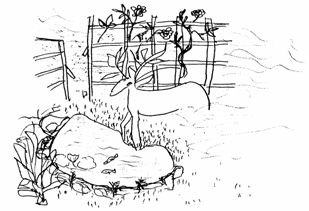
Once I saw a nimble
deer
after
a night of storm
come
through my fence,
through
flowers and mist,
to
drink from my pool at dawn.
A stranger from
another world
– all
grace and sensitivity –
it
stood quivering on my lawn.
A familiar voice
admonished me
in
words I have come to dread:
‘This deer will eat
your precious plants
and
trample your flowerbeds.
Don’t stand and stare –
be
vigilant,
and
act from common sense.
If you were a proper
gardener
you’d
drive it off
and
then repair the fence!’
From the upper window
where
I stood,
I saw how softly on
the grass
the
gentle creature trod,
as
if the bluebells in the nearby wood
had
trained it to tread
upon
the ground
as
one would tread
the
unearthly blue sky overhead,
without
crushing so much as a whisp of cloud.
How could I drive it
away?
I wanted rather to
honour its stay,
by
light of sun or moon –
this
wandering guest
from
the wilderness
who
would be gone too soon.
And so I watched
as
the mild deer stopped
and
mildly drank from my pond,
bestowing
on my garden
all
the blessing of the wild.
Now time has passed
and years gone by
since
the deer first used to come:
my
plants overflow, more precious than gold,
but
my garden fences I still dare
to
leave in a state of ill-repair.
And from where my
fence is broken
an
unseen deerpath runs
that
leads to a hidden woodland dell,
where
windflowers blow and nettles grow,
where
brambles stretch and ferns unfurl
and
timid little creatures dwell,
and
bluebells turning blue.
Into this woodland
garden
the
wild deer often stray,
and
there by light of sun or moon
I too would find my
way.