'Historical fiction at its best'
|
|
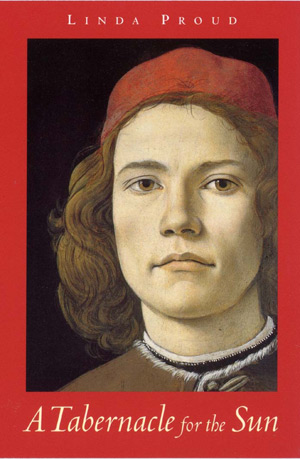
A TABERNACLE FOR THE SUN
What is the true nature of freedom, and where may it be found? This question
begins to haunt a young Volterrano boy called Tommaso after his city is
sacked and occupied by Florence. While his family becomes embroiled in
a plot to murder the Medici, Tommaso begins a search for wisdom. In Florence
he finds the Platonic Academy and its mysterious head, Marsilio Ficino,
but is told that he can make no further progress in his spiritual quest
until he has reconciled himself to Lorenzo de' Medici. This is something
he cannot do.
He seeks distractions in the workshop of Botticelli; he enjoys beauty of intellect in his employer, the poet Angelo Poliziano; he achieves wealth and satisfaction through his craft; but all the time the goddess of Wisdom is calling him, and to win her, all he need do is prostrate himself in front of the tyrant. . .
Published by Godstow Press [ISBN 0-9547367-2-9], price £12.50
REVIEWS
'The research in art, history and philosophy is breathtakingly thorough'
Ruth Padel (Daily Mail). 'Full of wisdom' Tim Pears (author). 'Historical
fiction at its best' Historical Novel Society. 'A time-travelling trance
of inspiration, straight to the heart of the Renaissance' Noel Cobb in
Sphinx 3. 'Astonishing tour-de-force' Dr. Pamela Tudor-Craig (art historian).
OTHER TITLES YOU MIGHT BE INTERESTED IN:
The Letters of Marsilio Ficino, translated by the School of Economic
Science, published by Shepheard-Walwyn (seven volumes):
Friend to Mankind, Michael Shepherd (ed), published by Shepheard-Walwyn
Ltd.
The Way of Hermes, Clement Salaman, Doreen van Oyen and William D. Wharton,
Duckworth Press.
The Temple of the Cosmos (Egyptian religion), by Jeremy Naydler, published
by Inner Traditions.
|
 | |
THE BOTTICELLI TRILOGY
The trilogy spans the years 1472-1499 and is mostly narrated by Tommaso dei
Maffei, an Italian exile living in Oxford. Having escaped Florence, he comes
to England in 1499 where he befriends John Colet, Thomas More and Erasmus. The
second volume, PALLAS AND THE CENTAUR, is now published, and the third volume
THE REBIRTH OF VENUS is due in 2006. The synopses for all three follow.

A TABERNACLE FOR THE SUN.
Tommaso de' Maffei is an eleven year old orphan living in Volterra, a small town of Etruscan origins subject to Florence. He grows up idolizing Lorenzo de' Medici, the young ruler of Florence. Since the discovery of alum in the territory of Volterra, however, the town has polarised between republicans and supporters of the Medici. Tommaso's cousin declares himself a republican, and sets up in Tommaso a conflict of loyalties between his dream hero and his native loyalties. Then to Volterra comes a new bishop.
Tommaso has lived his whole life in the bishop's palace, an empty place cared for by his grandfather. The new occupant brings discipline to the boy's life; he also brings a mysterious and inspiring philosophy, that of Plato. Plato had been unknown in the West until the fifteenth century; now he was the centre of a growing cult or wisdom tradition, centred in Florence. The head of the Platonic Academy is Marsilio Ficino, and his patron is Lorenzo de' Medici.
The political issues come to the boil. Volterra revolts against Florentine rule. Lorenzo de' Medici masses an army against the city, and in the end Volterra is sacked. Tommaso's love for his hero turns into pitch. Peversely, all his dreams now begin to be realised. He is taken to Florence by the bishop, and put to train as an apprentice scribe with the city's most notable bookseller. He begins to meet all his heroes and is befriended by Angelo Poliziano, for whom he begins to work. He still desires entry into the Platonic Academy, but he is told by Ficino that to do so he must open his heart, particularly to Lorenzo; to proceed on his spiritual path, he must surrender to the tyrant. This he cannot do.
The story is based on the true events of the Pazzi Conspiracy, which was an attempt on Lorenzo's life made by a band of men including Tommaso's cousin. It also outlines a young man's search for truth in a turbulent world, as relevant today as then. This quest, for the return of the soul to God, is exemplified by the design of the Primavera, and it is this painting which is being designed by Botticelli and his apprentice Filippino Lippi as the murderous plot gathers pace.
PALLAS AND THE CENTAUR
The second volume covers the life of the chief poet of the age, Angelo Poliziano,
from childhood up to 1482. His father was brutally murdered when Angelo was
just 9. According to the custom of the age, this made him an orphan even though
his mother still lived, for when a man died, his wife either remarried at once
or returned to her family with her dowry. In either case it was unlikely she
could keep her children. Although everyone knew the custom, it was still common
for men to grow up resenting their mothers for having 'abandoned' them. Poliziano
was one such. This psychic break with his own mother reflects in all his other
relationships with women, and he is torn apart like Orpheus. Against the custom
of the time, he strives to recreate his family of brothers and sisters, but
he cannot make himself whole until he has forgiven his mother. The story is
narrated partly by Poliziano's sister Maria and by his scribe Tommaso.
It is the book of the Renaissance Woman, and she is seen in all her aspects
through Poliziano's eyes. There is Lorenzo's mother, whom he adores for her
intelligence and wisdom; Lorenzo's wife, whom he abhors for her dogmatic piety
and illiteracy; his sister, who enchants him with her eccentric desire to be
just like him; Cassandra Fidelis, a learned woman who (in these years) frightens
him; and the Virgin Mary herself, whose image torments him with its ideal of
perfect motherhood. Woman twists and turns before the eyes of this confused
and unhappy man, until he learns to see her true nature.
THE REBIRTH OF VENUS
The third volume, currently in progress, bridges the fifteenth and sixteenth
centuries. The arrival of Savonarola in Florence brings a rejuvenation of Christianity
which, in the process, deals Florentine Platonism a mortal blow. The shattered
Academy survives in exile. Tommaso dei Maffei, in fear for his life, escapes
Florence and retreats to Venice and the printing house of Aldus Manutius. He
works hard to publish the collected writings of Poliziano and Pico della Mirandola.
Eventually he is forced to flee Italy for England and Oxford at the beginning
of the Reformation and the Tudor age. Here he becomes a part of the humanist
circle of John Colet. This volume opens in 1506, when Tommaso returns to Italy
as a companion to Erasmus, to try to solve the mystery of death, life, and the
immortality of the soul. He also needs to find what he has lost. . .
AUTHOR'S NOTE
The story was conceived in 1974 and took 11 years in research. To research
the Renaissance means becoming familiar with the history of just about everything,
and 700 books were either read or consulted in the course of the work. Since
the tendency of scholarship is to specialise, my work has been to put Humpty
Dumpty back together again, and make whole figures out of the mass of detail
now available. Often this leads to surprising discoveries, not least of which
is the character of Lorenzo. It is the current fashion to consider him a tyrant
and a model for Machiavelli's ideas, but I am satisfied in myself that a man
who could write such poetry as his could not be a tyrant (unfortunately the
writers of histories are not always readers of literature). The other character
who turned out very different to the portraits painted of him over the centuries
was Angelo Poliziano, Lorenzo's friend and Tommaso's employer. Like many before
him, his reputation has suffered from the evil of detractors, and has not yet
been fully restored.
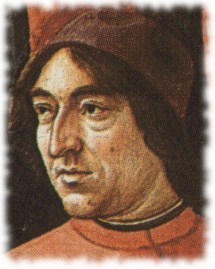
Portrait of Angelo Poliziano by Ghirlandaio